Banshee Roadmap
Aaron Bockover has just posted a new roadmap for Banshee.
Check out the "Goals for 0.11.x/HEAD" to see what's coming up... *drool*
Aaron Bockover has just posted a new roadmap for Banshee.
Check out the "Goals for 0.11.x/HEAD" to see what's coming up... *drool*
Sauerbraten 2006-24-06 Released
Linux-gamers.net has the scoop on the latest release of Saurbraten.
Mixx 1.5.0beta1 Released
Mixx is a powerful DJ mixing program for Linux and Windows. As far as I can tell, it's the best open source mixing program out there. In the latest beta, they've added pitch-independant time stretch, as well as fixed a bunch of annoying bugs. It looks like the development has also started to pick up again. This is a good project to keep an eye on...
Wormux
I downloaded and gave Wormux a shot today. It aims to be a free Worms clone for Linux, and that it definitely succeeds in. It feels pretty polished too. If you're a Worms fan, give it a shot. (Reminds me of Worms 2...) If you don't feel like adding an apt repository to your Ubuntu system to install the game, here's direct links to the two .debs you need: wormux-data-0.7.1, wormux-0.7.1 (just download the .deb from the directory corresponding to your distro)
Just spotted that customizable window shadows has just been added to compiz. :)
Also, a few updates ago, they added the "Novell" logo to the top of the cube as the default slide, if you don't set any up.
(If you didn't know, in XGL/Compiz, you can switch desktops in 3D as they're mapped onto the 4 outer sides of a cube. On the top of the cube, Compiz can display SVG images. The Novell logo on the top is now the default... Beats having just a white box if you're lazy like me.) :)
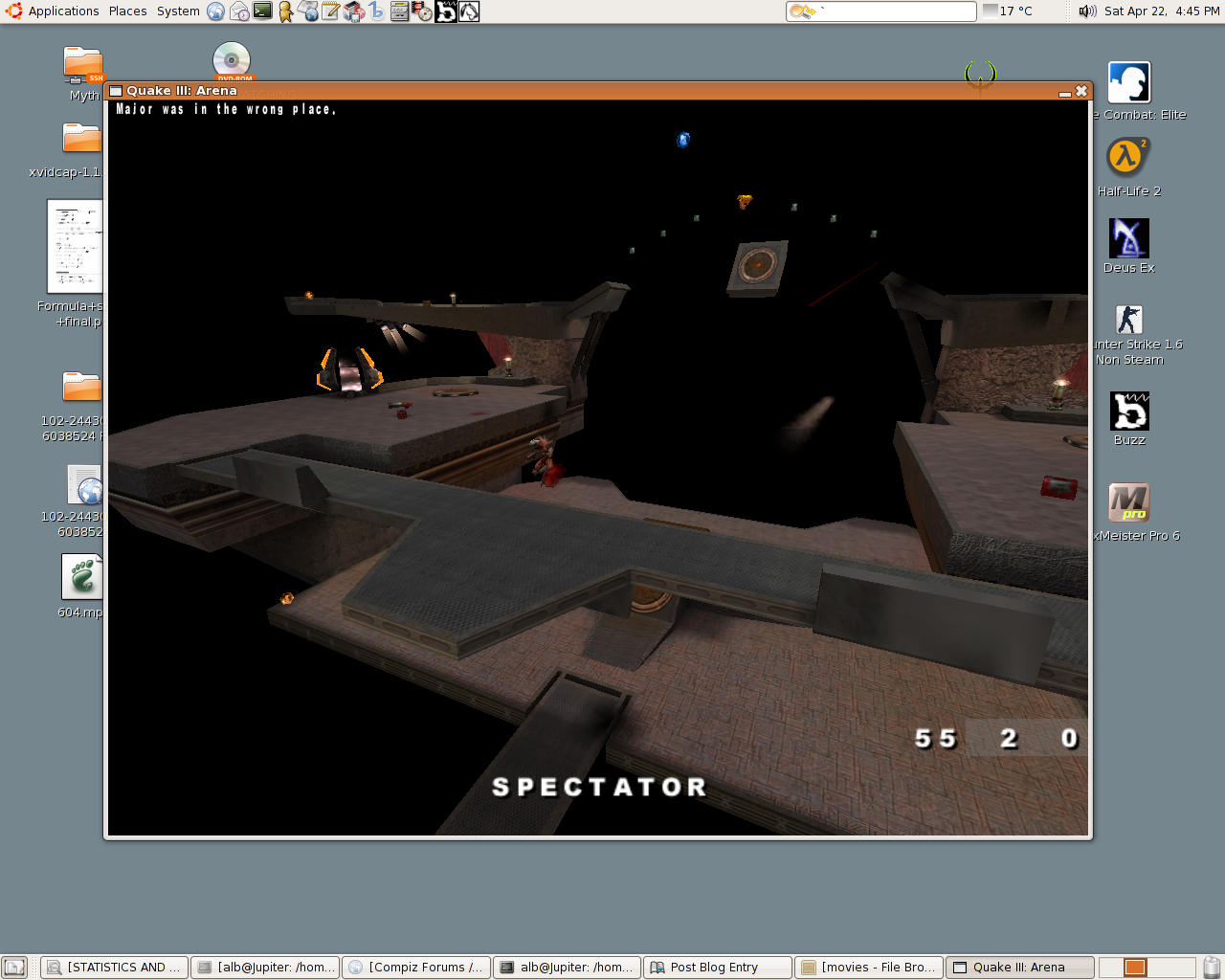
quake3 +set r_GLdriver "/usr/lib/nvidia/libGL.so.1.2.xlibmesa"
(The key is telling the engine specifically to use NVIDIA's libGL.)
While this fixes the missing texture problem, it still suffers from the performance loss that's incurred from running XGL. (We're still waiting for new NVIDIA/ATI drivers that feature complete hardware acceleration for XGL.)
Note: This was based off these UT instructions.
EDIT:
I've removed this article due to inaccuracies in it.
(Apparently I didn't research SMART enough... Thanks to my readers for pointing it out!)
I'd like to apologize for this mistake and any misinformation I may have spread. I'll do my best to triple check my facts in the future. ;)
If you're still curious, here's some links to the software's site:

Mark Shuttleworth (Ubuntu project leader) has just announced that the next version of Ubuntu will be codenamed "Edgy Eft".
Why should you be excited?
So dream a little about Xen for virtualisation, Xgl/AIGLX and other wonderful wobbly window bits, the goodness of Network Manager, a first flirt with multiarch support for true mixed 32-bit and 64-bit computing on AMD64, the interesting possibilities of the SMART package manager... and other pieces of infrastructure which have appeared tantalisingly
on the horizon.
If you've been following the latest developments in the Linux world, you'll undoubtably have heard of XGL and Compiz. If you haven't, XGL is a new X server written by David Reveman (at Novell) that uses OpenGL to accelerate all sorts of graphics rendering. Compiz is a window manager that features "compositing", allowing for things like window shadows, but also cool 2D/3D effects that use OpenGL. In non-technical terms, XGL uses your graphics card to make things snappier, and Compiz uses your graphics card to create very slick graphics for your desktop.
The key idea here is that it all uses your graphics card, which means it's not very taxing on your CPU (and in some cases can be faster than a non-accelerated X server.)
Why is this all such a big deal?
See for yourself.
(There's a bunch of XGL/Compiz videos out there, but this video is a good outline of the major features/bling.)
You want XGL/Compiz now, you say? There are several routes to go:
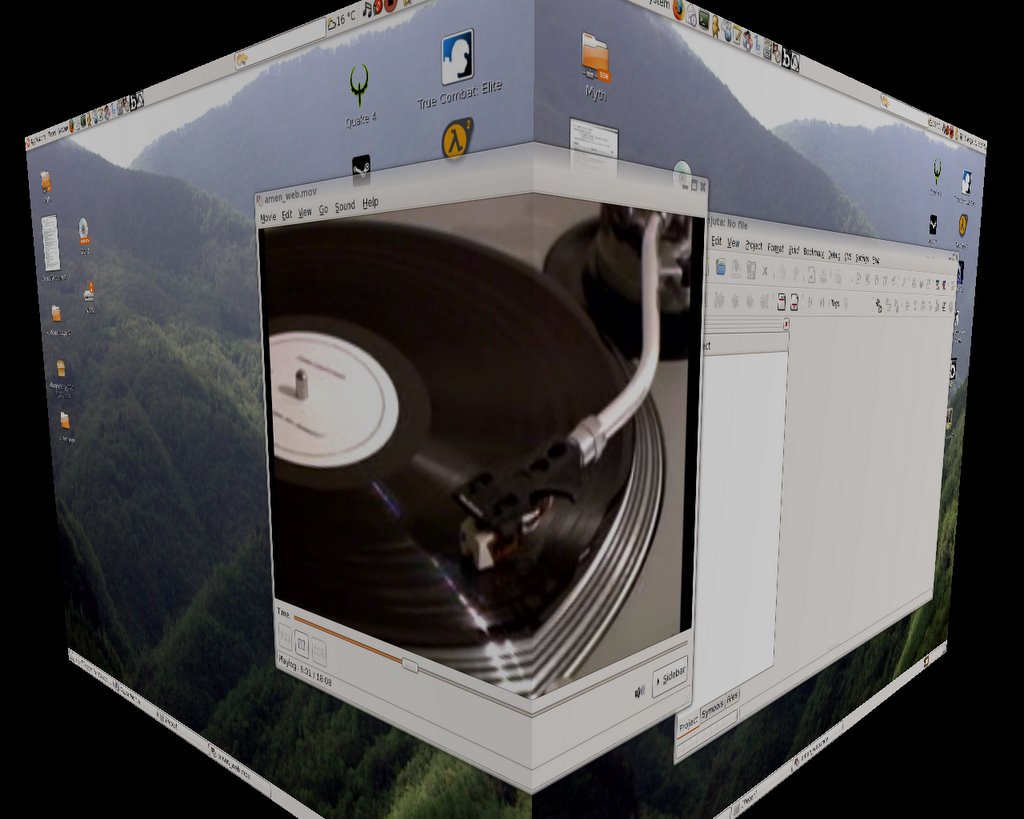 Playing a video across two desktops
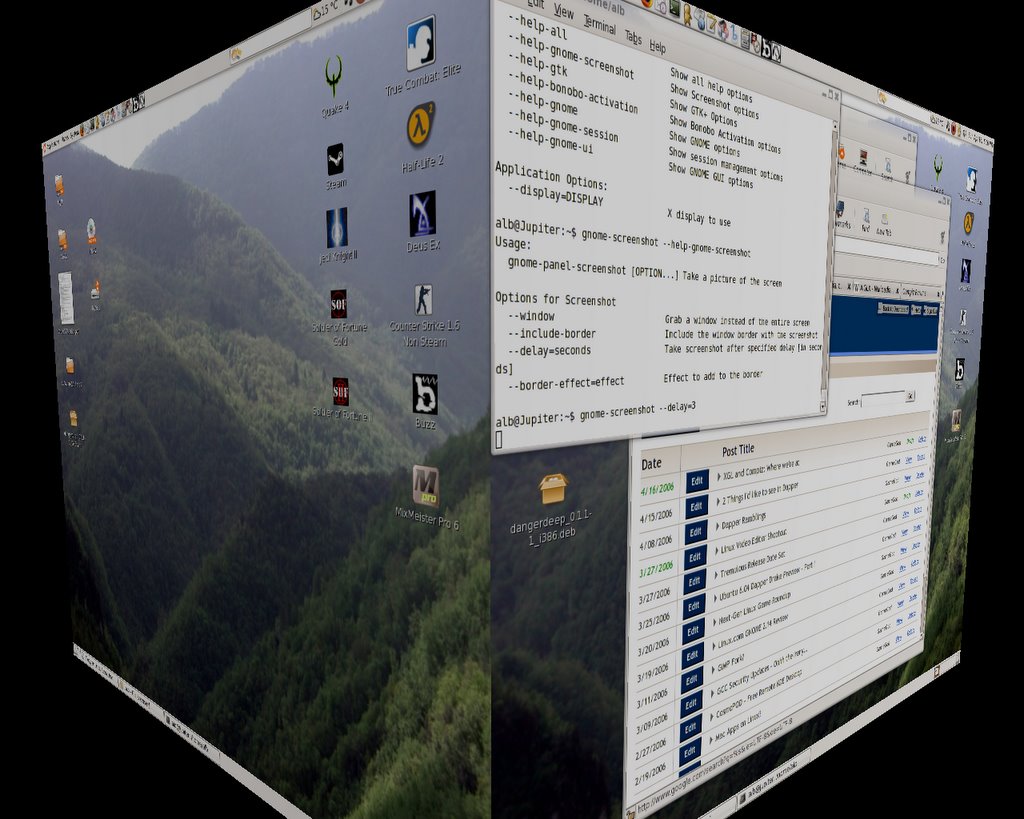 Another shot of rotating the cube
 The scale plugin in action (like Apple's "expose")


